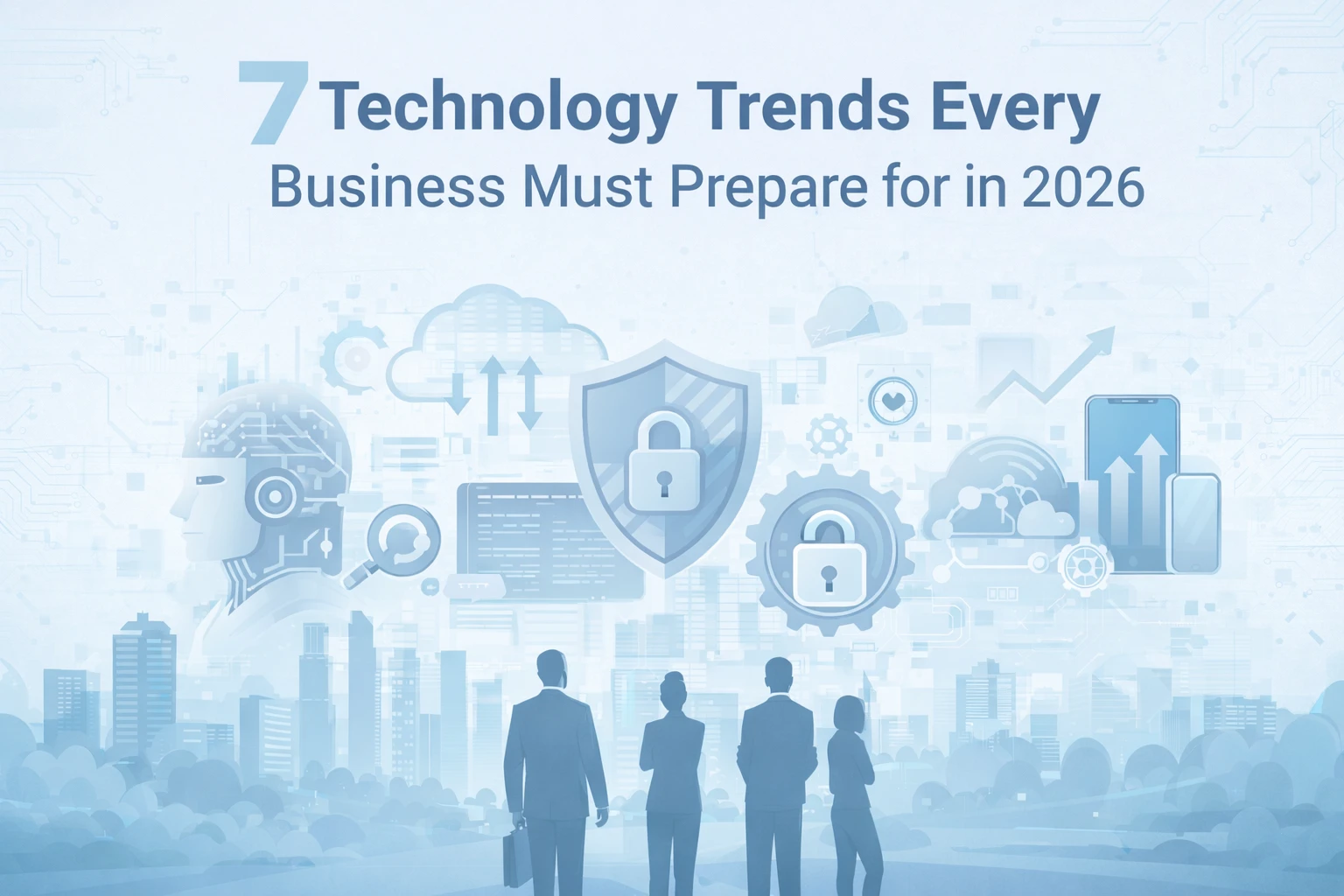
7 Technology Trends Every Business Must Prepare for in 2026
Digital transformation has moved beyond optional innovation. In 2026, technology directly influences revenue growth, customer trust, and operational resilience. Businesses that fail to modernize risk slower execution, higher costs, and reduced market relevance.
Emerging technologies enable organizations to respond faster to change, scale efficiently, and make smarter decisions using real-time data. Leaders must understand not only what these technologies are, but how they create measurable business impact.
Artificial Intelligence has evolved into a core enterprise capability. Predictive analytics applies AI models to historical and live data to forecast outcomes such as customer behavior, demand fluctuations, and operational risks.
This shift allows businesses to move from reactive decision-making to proactive planning.
Key business applications
• Sales forecasting and pipeline optimization
• Customer churn prediction
• Supply chain demand planning
• Risk assessment and fraud detection
According to Business Insider, companies are now allocating significantly larger budgets to AI initiatives that directly support production systems rather than experimental pilots, reflecting AI’s growing role in enterprise decision-making.
What leaders should prioritize
• Clear use cases tied to business outcomes
• Reliable and well-governed data sources
• Ethical AI policies and human oversight
Machine Learning enables systems to improve performance over time without constant manual intervention. Unlike rule-based automation, ML adapts as data patterns evolve.
In 2026, ML is deeply embedded across enterprise workflows rather than operating as a standalone technology.
How Machine Learning improves operations
• Automates complex decision processes
• Identifies inefficiencies invisible to humans
• Improves accuracy of predictions and recommendations
Common enterprise use cases
• Intelligent customer support routing
• Dynamic pricing models
• Predictive maintenance in manufacturing
• Financial anomaly detection
Successful ML adoption depends on continuous monitoring, model retraining, and alignment with operational goals.
Cloud-native development focuses on building applications that are scalable, resilient, and modular. These applications are designed specifically for cloud environments rather than migrated from legacy systems.
DevOps practices support this approach by enabling continuous integration, automated testing, and frequent releases.
Business benefits of cloud-native and DevOps
• Faster product launches
• Reduced downtime and failures
• Better collaboration between development and operations teams
Key practices businesses adopt
• Microservices architecture
• Containerization and orchestration
• Infrastructure as code
• DevSecOps for integrated security
In 2026, cloud maturity is measured by how quickly teams can deploy changes without compromising stability or security.
Progressive Web Apps deliver fast, reliable, and engaging user experiences directly through web browsers. They work across devices, load quickly, and function even with limited connectivity.
For many businesses, PWAs offer a better return on investment than native mobile apps.
Why businesses choose PWAs
• One application for all platforms
• Improved performance and speed
• Lower development and maintenance cost
• Higher engagement and conversion rates
A mobile-first strategy remains essential as buyers increasingly research, compare, and transact using mobile devices.
Low-code and no-code platforms allow applications to be built using visual interfaces rather than extensive manual coding. These platforms help organizations deliver solutions faster while reducing strain on development teams.
By 2026, low-code adoption is expected to dominate internal application development as enterprises seek agility.
Business advantages
• Faster solution delivery
• Reduced IT backlog
• Greater involvement from business users
Important governance considerations
• Centralized security controls
• Integration with core enterprise systems
• Clear ownership and lifecycle management
When properly governed, low-code platforms accelerate innovation without increasing risk.
Edge computing processes data closer to where it is generated rather than sending everything to centralized cloud systems. This approach reduces latency and enables real-time decision-making.
Edge computing is critical for environments where speed and reliability matter.
Key use cases
• Internet of Things systems
• Smart manufacturing
• Real-time monitoring and analytics
• Customer interaction platforms
In 2026, most enterprises adopt hybrid models that combine cloud scalability with edge responsiveness.
Modern digital environments extend across cloud, edge, and remote workforces. Traditional perimeter-based security models can no longer protect these distributed systems.
Zero-trust security assumes no user or device is trusted by default. Every access request must be verified.
Benefits of zero-trust and cybersecurity mesh
• Reduced risk of lateral movement during breaches
• Consistent security across environments
• Better visibility into access and behavior
Security in 2026 focuses on identity, continuous verification, and real-time threat response.

Emerging technology trends are not about adopting tools for the sake of innovation. They are about enabling smarter decisions, faster execution, and long-term resilience.
Businesses that invest strategically, modernize architecture gradually, and align technology with clear outcomes will be best positioned to compete in 2026 and beyond.
Preparation today defines relevance tomorrow.
The most important technology trends include AI and machine learning, cloud-native development, low-code platforms, mobile-first experiences, edge computing, and zero-trust security.
Predictive analytics forecasts future outcomes using data patterns, enabling businesses to act proactively on risks and opportunities.
Yes. Low-code platforms can be secure for enterprises when supported by strong governance models, role-based access controls, and standardized integrations.
Progressive Web Apps provide fast, reliable mobile experiences while reducing the cost and complexity of maintaining multiple native applications.
Zero-trust security means every user and device must be continuously verified before accessing systems, regardless of network location.
Companies should assess their current technology maturity, prioritize high-impact use cases, invest in relevant skills, and adopt new technologies in phased steps.