AI Chatbot vs AI Agent for Business
AI chatbot vs AI agent is no longer just another AI trend to evaluate. For most businesses, it has become a real decision tied to how they want to improve customer experience, automate work, and scale operations.
The problem is that these two terms are often used like they mean the same thing. They do not. While both use AI, they are built for very different outcomes. One is meant to handle conversations. The other is meant to handle work. Mixing them up usually leads to the wrong expectations, unnecessary complexity, and systems that do not create much business value.
An AI chatbot is useful when the goal is to answer questions, guide users, and improve responsiveness. An AI agent is useful when the goal is to complete tasks, make decisions, and move work forward across systems. Knowing that difference early makes it much easier to choose the right architecture, the right investment, and the right starting point.
What Is an AI Chatbot
An AI chatbot is a conversational software system designed to interact with users through text or voice and respond based on user input. Its primary role is to understand questions, interpret intent, and deliver relevant answers in a natural conversational format.
In business environments, AI chatbots are commonly used for customer support, lead qualification, internal helpdesk queries, and knowledge retrieval. They are typically the first layer of AI adoption because they improve communication without requiring deep workflow automation.
Most enterprise AI chatbots are built around:
• Natural language understanding to interpret user queries
• Intent detection to identify what the user wants
• Prompt based response generation for conversational replies
• Retrieval from internal knowledge sources and support content
• Limited workflow integrations for simple actions like routing or form capture
AI chatbots are optimized for answering questions, guiding conversations, and improving responsiveness. They are most effective when the business need is centered on communication, support, and user interaction rather than execution.
What Is an AI Agent
An AI agent is an autonomous software system designed to interpret goals, reason through tasks, make decisions, and execute actions across systems. Unlike an AI chatbot, an AI agent is built not just to respond, but to complete work.
AI agents are not limited to conversation. They can perform multi step workflows, call tools, interact with APIs, maintain memory, and complete tasks with minimal human input. This makes AI Agent Architecture for Business Automation especially valuable in enterprise environments where systems need to do more than assist.
In enterprise environments, AI agents are commonly used for:
• Sales workflow automation across CRM and outreach systems
• Customer success operations such as renewals, follow ups, and escalations
• Internal process execution across approvals, reporting, and task routing
• Research and reporting that require data gathering and summarization
• Multi system task automation across enterprise tools and workflows
AI agents are built for action, orchestration, and execution. They are most effective when the business requires automation, system coordination, and operational ownership.
At a high level, the difference becomes much clearer when compared across how each system is designed to operate.
AI Chatbot vs AI Agent: Key Differences
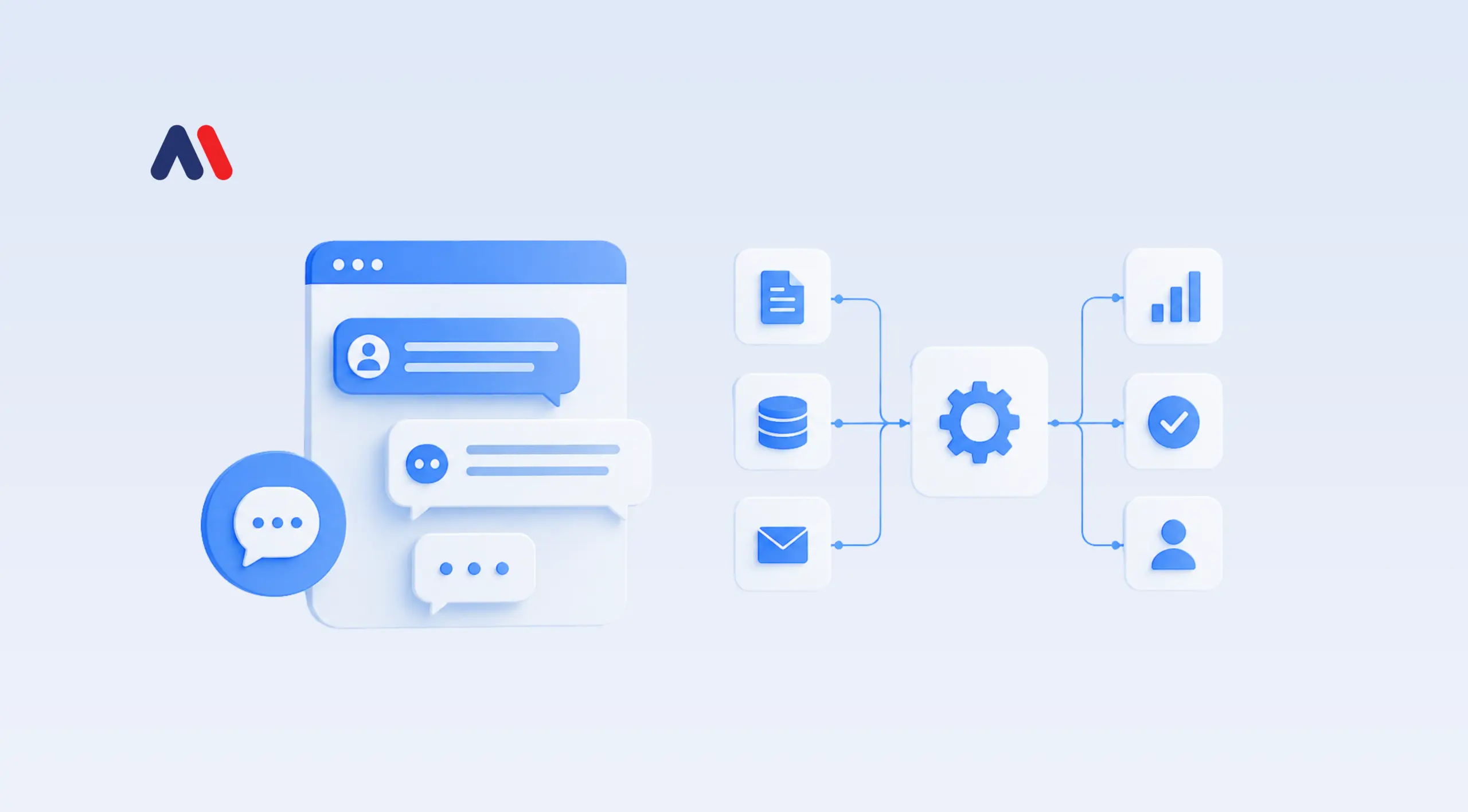
The core difference between an AI chatbot vs AI agent is simple. AI chatbots answer. AI agents decide and act. That difference affects architecture, implementation scope, governance, and business value.
| Comparison Area | AI Chatbot | AI Agent |
|---|---|---|
| Primary role | Conversational interface designed to interact with users through natural language | Goal driven system designed to complete tasks, make decisions, and take action |
| Core function | Responds to prompts, answers questions, and guides conversations | Interprets intent, plans next steps, executes tasks, and adapts based on outcomes |
| Decision making | Reactive and rule or prompt dependent | Autonomous, conditional, and capable of choosing actions dynamically |
| Memory | Limited, often session based or short term conversational memory | Persistent contextual memory across sessions, tasks, and workflows |
| Tool usage | Limited integrations such as CRM lookup, FAQ retrieval, or scripted actions | Dynamic orchestration across APIs, databases, business tools, and external systems |
| Workflow handling | Best for single interaction flows such as answering a question or collecting one input | Designed for multi step workflows such as research, approvals, updates, and execution |
| Governance complexity | Moderate, easier to monitor and control | High, requires stronger controls, permissions, auditability, and escalation logic |
| Time to deploy | Faster, often deployable in days or weeks | Longer, often requires phased implementation and governance design |
| Business value | Deflects repetitive workload and improves response efficiency | Automates operational workload and improves execution efficiency |
| Best for | FAQs, support bots, lead capture, internal Q&A, and guided assistance | Workflow automation, decision execution, task orchestration, and enterprise operations |
| Not ideal for | Complex automation, multi step execution, and autonomous decisions | Simple FAQs or basic support where a chatbot is sufficient |
When Businesses Should Build an AI Chatbot
Businesses should build an AI chatbot when the primary goal is to improve communication efficiency and handle high volumes of repetitive interactions without increasing manual support effort.
AI chatbots are the right fit when the system needs to:
• Answer repetitive customer questions instantly and consistently across channels
• Surface relevant knowledge base content based on user queries
• Route conversations to the right team based on intent or issue type
• Qualify inbound leads before handing them over to sales teams
• Reduce support workload by automating first level interactions
• Improve response times across customer support, sales, and service channels
For businesses focused on customer interaction, AI chatbots are often the fastest and most cost effective entry point into enterprise AI. They are especially useful when the goal is to improve responsiveness, reduce support dependency, and create always available communication across digital touchpoints.
When Businesses Should Build an AI Agent
Businesses should build an AI agent when the goal is workflow execution and operational automation, not just conversational interaction.
AI agents are the right fit when the system needs to:
• Complete tasks across multiple systems without requiring manual coordination
• Trigger workflows automatically based on events, inputs, or business logic
• Make decisions using context, predefined rules, and system level data
• Coordinate tools, APIs, databases, and enterprise systems in real time
• Execute internal operations autonomously with minimal human intervention
• Reduce operational overhead by automating repetitive business processes at scale
If the business problem requires action, orchestration, and end to end workflow ownership, an AI agent is the stronger architectural choice. AI agents are better suited for enterprise environments where efficiency depends on systems taking action, not just responding to requests.
Real World Examples in the Market
AI Chatbot Examples
Drift is a strong example of an AI chatbot built for conversational sales and lead generation. It helps businesses engage website visitors, qualify inbound leads, and route prospects into the sales pipeline faster.
Zendesk AI is widely used in customer support environments to automate common support conversations, suggest responses, and route service requests to the right teams with less manual effort.
AI Agent Examples
Salesforce Agentforce is an enterprise AI agent platform built to autonomously execute sales, service, and CRM workflows across business systems, moving beyond conversation into action.
ServiceNow AI Agents are designed for enterprise workflow automation, helping businesses automate IT operations, HR requests, approvals, and internal service workflows with minimal human intervention.
These examples show the market distinction clearly. AI chatbots improve interactions and communication efficiency. AI agents automate execution, workflows, and operational work.
Cost and Complexity Comparison
AI chatbot development is usually faster, more affordable, and easier to launch for most businesses. It requires less infrastructure, fewer dependencies, and simpler workflows, which makes it a practical starting point for teams adopting AI.
AI Chatbot Development
Typically best suited for:
• Faster deployment with shorter implementation timelines
• Lower implementation cost and lighter technical overhead
• Simpler integrations across existing business systems
• Lower governance effort with easier monitoring and control
AI Agent Development
Typically requires:
• Workflow orchestration across systems and business logic
• Tool and API infrastructure for task execution
• Memory systems for context and continuity
• Human approval layers for oversight and exception handling
• Monitoring, audit controls, and stronger governance
• Higher implementation cost and operational complexity
For most businesses, AI chatbots are the lower risk starting point. AI agents become more valuable when workflow automation and operational efficiency justify the added complexity.
Security and Enterprise Risk Considerations
Choosing between an AI chatbot and an AI agent is also a security and governance decision. In enterprise environments, the difference matters because AI chatbots introduce conversational risk, while AI agents introduce execution risk.
AI Chatbot Risks
AI chatbots generally carry lower operational risk, but they still require oversight. Common risks include:
• Incorrect or misleading responses
• Hallucinated content without factual grounding
• Weak retrieval from incomplete or outdated knowledge sources
• Data exposure in user conversations
AI Agent Risks
AI agents carry higher enterprise risk because they can take action across systems. Common risks include:
• Unauthorized actions without proper controls
• Faulty workflow execution due to poor logic or context
• Tool misuse across connected systems and APIs
• Cross system access risks involving permissions and data boundaries
• Greater audit, compliance, and accountability complexity
Enterprise AI agent development should include:
• Role based access controls to limit permissions
• Approval checkpoints for sensitive actions
• Action guardrails to prevent unsafe execution
• Audit logging for traceability and compliance
• Human in the loop review for oversight
• Policy driven execution limits across systems
How to Decide What Your Business Should Build First
The right choice depends on the business outcome you are trying to improve. The decision is less about which technology is more advanced and more about what problem the business is solving first.
Build an AI chatbot if your priority is:
• Customer support automation across high volume conversations
• Lead qualification before routing prospects to sales teams
• Faster response times across customer facing channels
• Internal knowledge retrieval for employees and support teams
Build an AI agent if your priority is:
• Workflow automation across systems and business functions
• Task execution without repeated manual intervention
• Operational efficiency across repetitive internal processes
• System orchestration across tools, APIs, and enterprise platforms
Build both if your business needs a conversational front end with autonomous backend execution. This is the model many enterprises are now adopting, where the chatbot handles the interaction and the AI agent completes the task.
A simple ecommerce example is Sephora. Sephora uses AI to help customers ask product questions, get personalized recommendations, and find the right products based on preferences like skin type or style. That is a chatbot use case focused on guiding conversation and improving the shopping experience.
The agent layer begins when AI moves beyond recommendations and starts taking action, such as booking appointments, checking inventory, or helping complete purchases. Sephora is a practical example of how ecommerce businesses can start with conversational AI and gradually extend into workflow driven automation.
Conclusion
The difference between an AI chatbot and an AI agent is not about which one is more advanced. It comes down to what your business actually needs.
If the goal is to improve communication, handle support faster, or make customer interactions easier to manage, an AI chatbot is usually the better fit. If the goal is to automate workflows, reduce manual effort, and get systems to do more of the work, an AI agent makes more sense.
In many cases, the best approach is not choosing one over the other. It is using both where they make sense. The chatbot handles the conversation. The agent handles the execution behind it.
For businesses exploring enterprise automation, this is where thoughtful implementation matters. At AcmeMinds, we help teams design and build practical AI systems, from conversational chatbots to agentic AI solutions built for real business workflows. If you are still evaluating where to begin, it is also worth understanding how different AI models fit different business needs and where agentic systems make more sense than assistive ones.
FAQs
1. What is the difference between an AI chatbot and an AI agent?
An AI chatbot is designed to answer questions and manage conversations. An AI agent is designed to make decisions, execute tasks, and automate workflows across systems.
2. Is an AI agent better than an AI chatbot?
Not always. AI chatbots are better for communication focused use cases like support and lead capture. AI agents are better for workflow automation and task execution.
3. When should a business use an AI chatbot?
A business should use an AI chatbot when the goal is customer interaction, support automation, FAQ handling, or conversational lead qualification.
4. When should a business use an AI agent?
A business should use an AI agent when the goal is automating workflows, executing tasks, orchestrating systems, or reducing manual operations.
5. Are AI agents more expensive than AI chatbots?
Yes. AI agents are typically more expensive to build and operate because they require orchestration, memory, governance, and system level execution controls.
6. Can a business use both an AI chatbot and an AI agent?
Yes. Many enterprises use AI chatbots as the front end conversational interface and AI agents as the backend execution layer for workflows and automation.
More on AI
Why Autonomous Agents Are Replacing Traditional AI Pipelines