How to Design AI-First SaaS Products
Software is shifting from rule-based systems to systems that learn from data. In many modern SaaS products, intelligence is at the core of how the product works, makes decisions, and delivers value.
This shift changes how products need to be designed. Instead of defining every workflow upfront, teams now build systems that improve over time based on usage, data, and feedback.
Designing AI-first SaaS products requires a different approach. It involves structuring data pipelines, selecting the right models, and building scalable infrastructure that can support continuous learning while maintaining reliability and performance.
According to a report by McKinsey, over 50 percent of organizations have adopted AI in at least one business function, highlighting how rapidly AI-driven systems are becoming mainstream.
What Is an AI-First SaaS Product
An AI-first SaaS product is designed with artificial intelligence at its core rather than as a secondary feature. The application relies on data and machine learning models to drive key functionality and decision-making across the system.
Instead of following fixed rules, these products continuously learn from user interactions, historical data, and real-time inputs to improve outcomes over time.
Examples include:
- Recommendation engines in ecommerce platforms
- Predictive analytics dashboards for business insights
- AI-powered customer support systems with automated responses
- Intelligent workflow automation tools that adapt to user behavior
For example, AI-powered customer support platforms that classify tickets, recommend responses, and improve resolution speed over time. Or like a Predictive sales SaaS platform that score leads, forecast conversions, and automate follow-up workflows.
In these systems, AI directly influences how the product behaves and evolves over time. This allows businesses to deliver more personalized experiences, improve efficiency, and make faster, data-driven decisions.
How AI-First SaaS Differs from Traditional SaaS
Traditional SaaS products are built on predefined rules and fixed workflows. Every action and outcome is designed in advance, which makes the system predictable but limited in how it adapts to changing user behavior.
AI-first systems operate differently. They learn from data, identify patterns, and improve performance over time without requiring constant manual updates.
Key differences include:
- Static logic versus adaptive systems that evolve with new data
- Feature-based development versus data-driven decision making
- Predictable outputs versus probabilistic outcomes based on model predictions
- Limited personalization versus dynamic, user-specific experiences
This shift changes how products are built and managed. Teams need to account for model training, data quality, and continuous improvement cycles. It also impacts testing, since outputs are no longer fixed but can vary based on inputs and learning over time.
Core Principles of AI Product Design
Designing AI-first SaaS products requires a strong set of principles that guide both product thinking and engineering decisions. Unlike traditional systems, AI products depend heavily on data, model behavior, and continuous improvement, which makes early design choices critical.
Key principles include:
- Data-first thinking
Data is the foundation of any AI system. Product decisions should prioritize data quality, availability, and consistency across the entire lifecycle - Continuous learning systems
AI models should improve over time through structured feedback loops, retraining pipelines, and performance evaluation - Explainability and transparency
Users should have clarity on how AI-driven outputs are generated, especially in decision-critical workflows - Human oversight
Important actions should include human validation where required to reduce risk and improve trust - Performance monitoring
AI systems must be continuously evaluated for accuracy, bias, and model drift to ensure consistent performance
Applying these principles helps teams build AI features that are reliable, scalable, and aligned with real business outcomes rather than just technical capabilities.
For example, an AI recruiting platform must continuously improve candidate ranking accuracy through structured feedback, while still allowing recruiters to review and override recommendations when needed.
AI Architecture for SaaS Applications
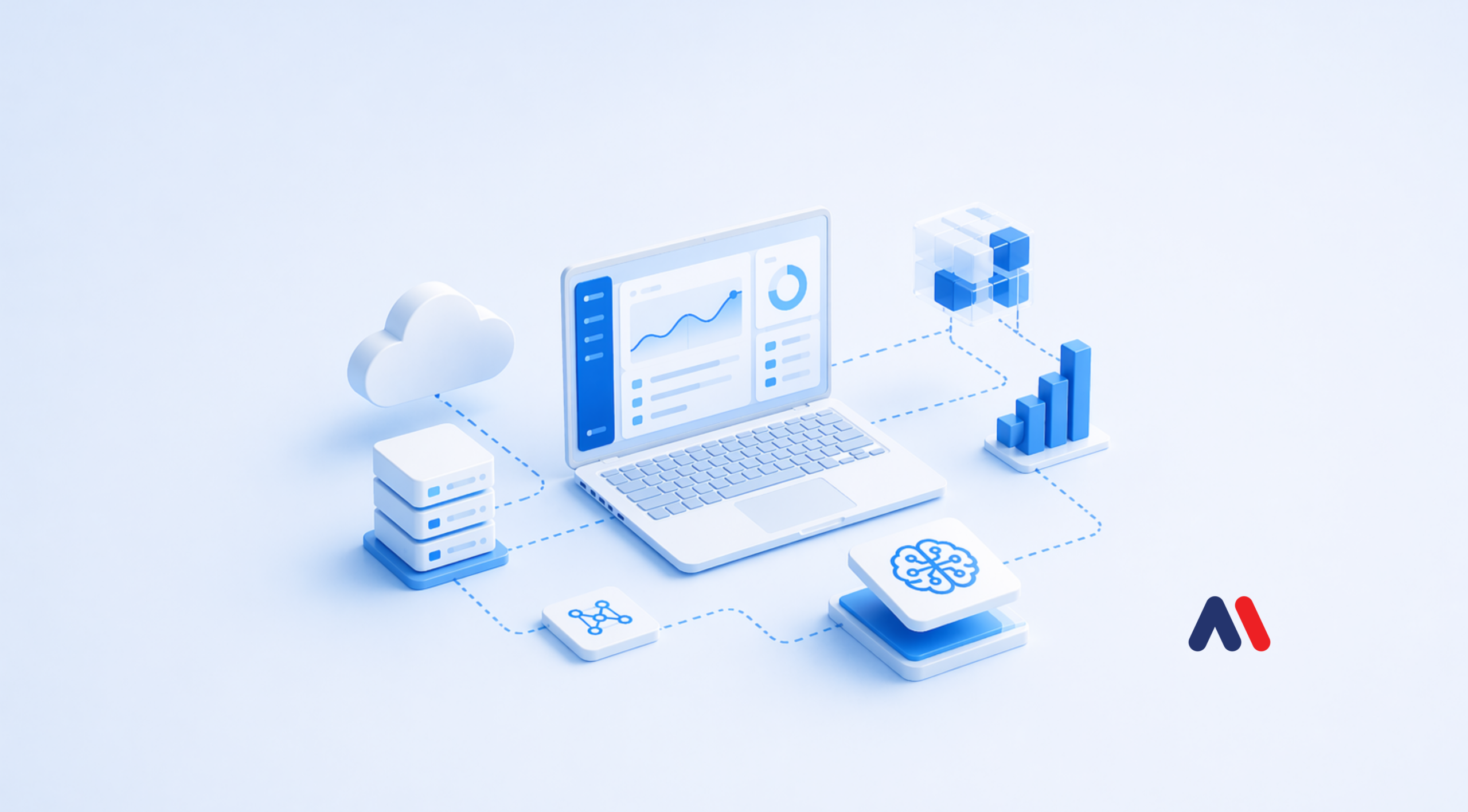
AI-first SaaS architecture combines traditional software components with machine learning systems to create intelligent, scalable, and adaptive applications that continuously improve with data.
Key components include:
- Application layer for business logic, user workflows, and core product functionality, ensuring smooth interaction between users and system features.
- Model layer where machine learning models are trained, validated, deployed, and continuously optimized based on new data and feedback loops.
- Data layer for storing structured and unstructured data, including user activity, logs, events, and training datasets that power AI systems.
- API layer to connect models with frontend and backend applications, enabling real-time inference and seamless service integration across modules.
- Monitoring layer for tracking performance, accuracy, latency, drift, and system usage to ensure reliability and model effectiveness in production environments.
A modular architecture helps teams independently update models, scale services, and integrate new features without affecting the entire system, improving agility and reducing deployment risks while supporting long-term system evolution.
Data Pipelines and Model Selection
Data pipelines are essential for collecting, processing, and preparing data for AI models.
Key elements include:
- Data ingestion from multiple sources such as user activity and external APIs
- Data cleaning and transformation to ensure accuracy
- Feature engineering to improve model performance
- Model selection based on use case such as classification, prediction, or generation
Choosing the right model depends on:
- Type of problem being solved
- Availability and quality of data
- Latency and performance requirements
A strong data pipeline directly impacts the success of AI-driven features.
For example, an AI finance platform that predicts cash flow depends on clean accounting data, categorized transactions, and reliable forecasting models to generate useful insights.
Designing User Experiences for AI Products
User experience plays a critical role in the adoption and success of AI-powered products. Even if an AI system is highly accurate, users will not trust or continue using it if the experience feels confusing, unpredictable, or unclear. That is why AI systems must be designed to feel intuitive, predictable, and trustworthy in everyday use.
Key considerations include:
- Clear communication of AI outputs and recommendations so users understand what the system is suggesting and why it is making a particular decision, without needing technical knowledge.
- Feedback mechanisms for users to improve system accuracy, allowing them to correct outputs, confirm suggestions, or refine results so the model learns over time.
- Handling uncertainty in AI responses by clearly indicating confidence levels or limitations instead of presenting uncertain outputs as absolute answers.
- Designing fallback options when AI fails, such as manual controls, alternative suggestions, or human support paths to ensure the workflow is never blocked.
Well-designed AI UX ensures users remain confident in the system even when outcomes are probabilistic or not always perfect. It bridges the gap between complex machine learning models and real-world usability, making AI feel more like a helpful assistant rather than a black box system.
For example, in an AI healthcare platform, clinicians should be able to see why a diagnosis was suggested, review confidence levels, and make the final decision before action is taken. This improves trust, usability, and safety in decision-critical workflows.
Scalability and Infrastructure for AI SaaS
AI workloads demand infrastructure that can scale efficiently as data volumes, user activity, and computational requirements grow. Unlike traditional SaaS systems, AI-powered platforms must support intensive processing, continuous model execution, and fast response times without compromising reliability.
Important considerations include:
- Cloud-based infrastructure for flexibility, elasticity, and seamless scaling across environments
- Distributed computing to process large datasets and support parallel model workloads efficiently
- Real-time processing for latency-sensitive applications such as recommendations, automation, and intelligent search
- Efficient resource management to optimize compute usage, reduce waste, and keep infrastructure costs under control
A scalable infrastructure foundation ensures AI systems remain responsive, cost-efficient, and reliable as usage increases and workloads become more complex.
Challenges in Building AI-First SaaS Products
Building AI-first SaaS products introduces a new set of challenges that go beyond traditional software development. Unlike conventional SaaS platforms, AI systems must manage evolving data, adaptive models, and higher operational complexity from day one.
Key challenges include:
- Data quality and availability issues that directly impact model reliability and output accuracy
- Model accuracy drift and performance degradation as user behavior, inputs, and real-world conditions change over time
- Integration with existing systems such as CRMs, ERPs, internal tools, and fragmented data sources
- High infrastructure and compute costs driven by model training, inference workloads, and large-scale data processing
- Ensuring ethical and unbiased AI behavior through responsible training, transparent logic, and ongoing governance
Addressing these challenges requires strong engineering foundations, continuous monitoring, and disciplined iteration across both infrastructure and model performance.
For example, an AI logistics platform may perform well initially, but changing delivery patterns, weather conditions, or supply chain disruptions can quickly reduce model accuracy without continuous retraining.
Best Practices for AI SaaS Development
Organizations building AI-first SaaS products should focus on a strong technical foundation from the start. Long-term success depends not only on model performance, but also on how well the system is designed to scale, adapt, and deliver consistent business value.
Key best practices include:
- Building strong data pipelines early to ensure clean, consistent, and reliable data flows across the system
- Designing modular and scalable architecture that supports flexibility, faster iteration, and future expansion
- Continuously monitoring model performance to detect drift, maintain accuracy, and improve reliability over time
- Implementing feedback loops that help models learn from user behavior and improve with real-world usage
- Prioritizing security and data privacy to protect sensitive information and maintain compliance across workflows
- Aligning AI capabilities with real business use cases so every model serves a measurable product or operational goal
These practices help teams build AI systems that are reliable, scalable, and capable of delivering meaningful business impact over time.
For example, an AI fraud detection platform depends on clean transaction data, real-time model monitoring, and continuous retraining to maintain detection accuracy as fraud patterns evolve.
Examples of AI SaaS Products in the Market
AI-first SaaS products are already widely used across industries, with many modern platforms building their core value around machine learning, automation, and intelligent decision-making. These products show how AI can move beyond feature enhancements and become central to how SaaS platforms operate and deliver value.
Examples include:
- Salesforce Einstein, which brings predictive lead scoring, sales forecasting, and AI-driven CRM insights into enterprise sales workflows
- Zendesk AI, which helps automate customer support through intelligent ticket routing, response suggestions, and support automation
- Gong, which uses AI to analyze sales conversations, identify buying signals, and improve sales team performance
- Jasper, which applies generative AI to content creation for marketing teams, blogs, product copy, and campaign workflows
- UiPath, which combines automation and AI to streamline enterprise workflows, repetitive tasks, and business operations
- PathAI, which uses AI in healthcare to assist pathologists with diagnostics and clinical decision support
These platforms demonstrate how AI SaaS products apply machine learning in practical business environments, whether through automation, prediction, content generation, decision support, or operational intelligence.
Conclusion
Building AI-first SaaS products requires more than adding AI features to traditional software. It means designing data pipelines, architecture, user experience, and infrastructure around intelligence from the start.
The most effective AI SaaS products are built to learn continuously, scale efficiently, and solve real business problems.
At Acmeminds, we help businesses design and build AI-first SaaS products with scalable architecture, production-ready AI workflows, and strong engineering foundations built for growth. Whether you are building a new AI SaaS platform or adding intelligent capabilities to an existing product, the right technical foundation determines how well that product performs at scale.
FAQs
1. What is an AI-first SaaS product?
An AI-first SaaS product is a cloud-based software application where artificial intelligence powers the core product experience rather than functioning as an optional feature. In these systems, AI drives key workflows such as automation, prediction, personalization, recommendations, and decision support, making intelligence central to how the product delivers value.
2. How do you design an AI SaaS product?
Designing an AI SaaS product starts with identifying high-value use cases where AI can improve automation, efficiency, or user experience. The process typically includes defining workflows, building reliable data pipelines, selecting suitable machine learning models, designing scalable cloud architecture, and creating intuitive interfaces that make AI outputs easy to understand and use.
3. What technologies are used in AI SaaS applications?
AI SaaS applications commonly rely on cloud platforms, machine learning frameworks, APIs, data engineering tools, and containerized infrastructure. These technologies work together to support model training, real-time inference, secure integrations, scalable deployment, and efficient data processing across production environments.
4. What is the role of data in AI SaaS products?
Data is the foundation of AI SaaS products because it trains, validates, and continuously improves machine learning models. High-quality data enables better predictions, stronger automation, and more accurate recommendations. As users interact with the product, new data helps refine model performance and improve outcomes over time.
5. What are the biggest challenges in AI SaaS development?
The biggest challenges in AI SaaS development include maintaining data quality, improving model accuracy, scaling infrastructure, managing complex integrations, and preventing model drift over time. Teams must also balance performance, cost, reliability, and user trust while ensuring AI systems remain production-ready as they grow.
6. How do AI SaaS products scale?
AI SaaS products scale through cloud-native infrastructure, distributed systems, optimized data pipelines, and modular architecture. By separating model services, data systems, and application logic, teams can scale workloads independently, improve performance, and support larger user volumes without compromising speed or reliability.
More on AI

Why Autonomous Agents Are Replacing Traditional AI Pipelines