AI Automation for Enterprise Systems
Enterprise AI automation is often discussed as if it is one capability. It is not.
For one business, it may mean extracting and validating information from thousands of incoming documents. For another, it may mean helping clinicians turn encounter conversations into structured draft notes. For an engineering team, it may mean removing manual steps from testing and deployment.
The technology may look different in each case, but the business question is the same: can this workflow move faster and more reliably without creating more risk, more exceptions, or less accountability?
At AcmeMinds, the answer is rarely found in a standalone AI tool. It comes from connecting AI to the systems, rules, data, and people already responsible for the work.
AI Is Changing Enterprise Automation
A model can summarize a document, classify a request, generate a note, or suggest an action. That alone is not enterprise automation.
Enterprise automation begins when AI output triggers a useful next step inside a real business process.
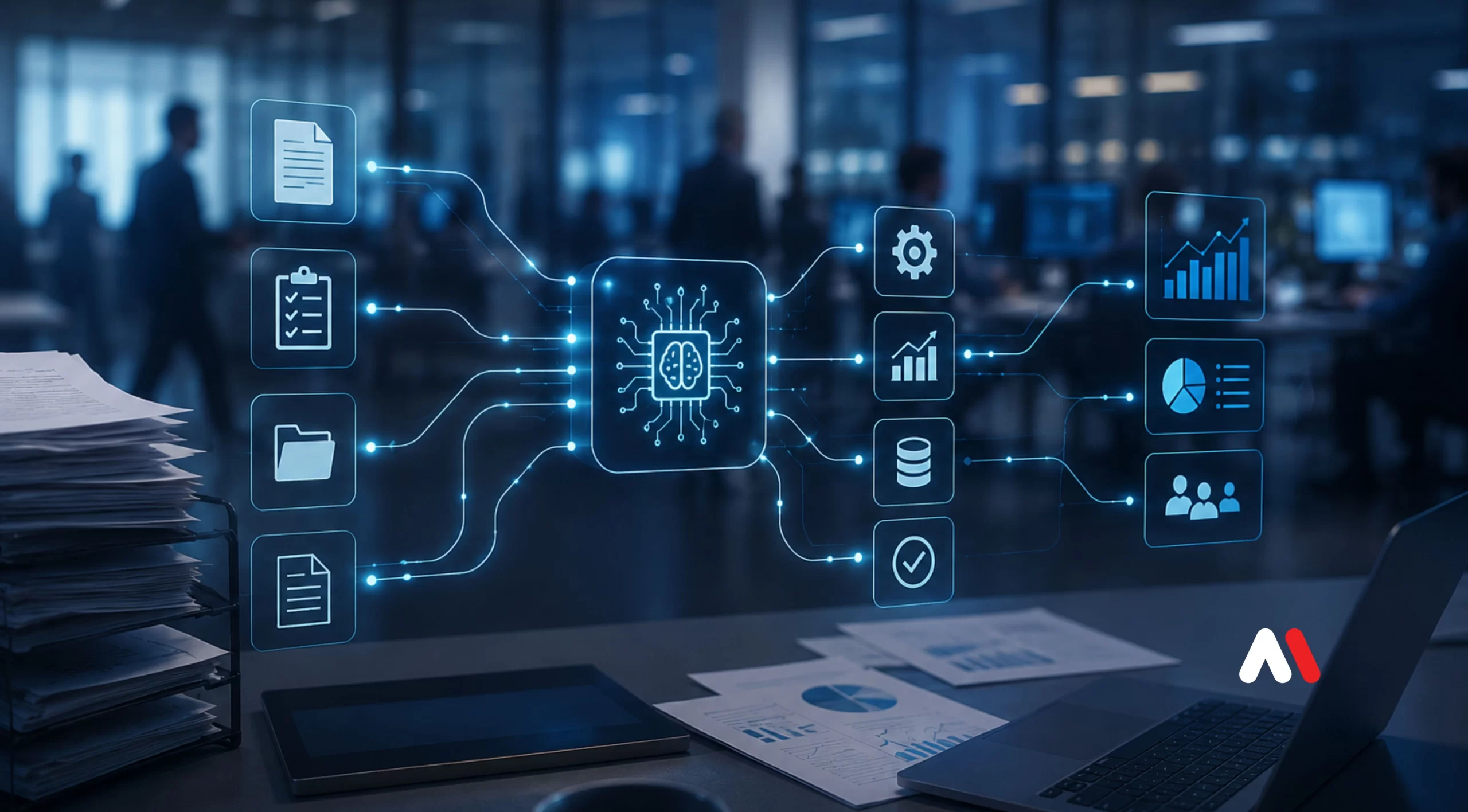
For example, a document automation system should not stop at reading a file. It should identify the relevant information, match it to the correct record, apply business rules, route uncertain cases to a reviewer, and update the right system of record.
That is why the strongest automation programs are not built around prompts alone. They combine:
- AI interpretation to understand documents, conversations, requests, or unstructured data.
- Business rules to determine what can proceed, what needs validation, and what requires approval.
- System integrations to move information into the CRM, EHR, financial system, workflow platform, or database where work actually happens.
- Human review for exceptions, sensitive decisions, and situations where confidence is low.
AI is important. The operating workflow around it is what creates enterprise value.
The AcmeMinds Approach to Enterprise AI Automation
Successful AI automation projects rarely begin with AI.
They begin with understanding how work moves across an organization. Before recommending a model, framework, or automation platform, we first identify where time is being lost, where decisions slow down, and where repetitive work prevents teams from focusing on higher-value outcomes.
Our approach is built around four principles.
Start With the Business Process
Technology should solve an operational problem, not create a new one.
We map the complete workflow before writing a single line of code. That includes the systems involved, decision points, approvals, exceptions, and the people responsible at every stage. This allows us to identify where AI adds measurable value instead of introducing unnecessary complexity.
This product-first approach is equally important for organizations developing AI-powered SaaS products, where scalability, security, and user workflows must be considered from the very beginning.
Keep Humans in Control
Enterprise AI should accelerate decisions, not replace accountability.
For routine, high-confidence tasks, automation can move work forward automatically. For exceptions, sensitive information, or business-critical decisions, the workflow should always include the right person for review and approval.
Build Around Existing Systems
The best automation feels like part of the business, not another application employees have to learn.
Whether the workflow depends on an ERP, CRM, EHR, internal platform, or custom software, AI should integrate with existing systems so information flows naturally across the organization instead of creating another silo.
Design for Long-Term Scale
We build enterprise automation with modular architecture, secure integrations, auditability, and extensibility so businesses can expand from one workflow to many without rebuilding the foundation each time.
This approach has helped organizations automate document-intensive operations, streamline clinical workflows, and accelerate software delivery while maintaining the governance and operational control enterprise teams expect.
What Makes Enterprise AI Successful
The biggest enterprise automation mistake is treating AI output as the final answer.
The success of an enterprise AI initiative is rarely determined by the model itself. It depends on how decisions are governed, how exceptions are handled, and how AI fits into existing business operations. Without these foundations, even the most capable model becomes another disconnected tool.
A dependable AI automation workflow usually follows this model:
- AI interprets the input. It extracts information, classifies a request, summarizes content, or identifies a likely next action.
- Rules validate the result. The system checks the output against business conditions, required fields, permissions, and data quality requirements.
- Confidence determines the route. High-confidence, low-risk cases can move forward. Low-confidence, incomplete, or high-impact cases go to a qualified reviewer.
- The action is recorded. The system keeps a trace of the source, AI output, human changes, approvals, and final outcome.
This is the difference between an AI feature and an enterprise-ready automation system. The system does not simply produce an answer. It helps the business act on that answer responsibly.
Three Automation Builds, Three Lessons
Atlas: Automation Must Make a Decision
For Atlas, AcmeMinds built an AI-powered document automation system for a lending workflow. The platform extracted data from incoming documents, matched files to the correct client and loan records, and used confidence-based routing to determine whether the workflow could proceed or needed human review.
The project reduced manual document handling by 95% and improved team productivity by 60%.
What this shows: Document automation becomes valuable when it can interpret, match, validate, and route. Reading documents is only the first step.
Assemblage Health: AI Should Support Expert Work
For Assemblage Health, AcmeMinds integrated AI transcription and language models into a clinical workflow platform. The system converted encounter audio into draft notes, then supported clinician review, editing, and final sign-off.
The platform also required EHR integrations, role-based access, encryption, and audit logging because the workflow involved sensitive healthcare information.
What this shows: In high-stakes environments, AI should reduce administrative work while the qualified professional retains control of the final decision.
Automated CI/CD: Automation Can Improve the Product Team Itself
For an automated CI/CD implementation, AcmeMinds replaced manual deployment processes with Jenkins-based pipelines for builds, testing, environment deployments, alerts, approvals, and recovery.
The result was 80% faster deployment cycles, three times more frequent releases, and 95% fewer deployment-related errors.
What this shows: AI and automation strategy should not focus only on external operations. Improving the way software is tested and released can create a direct advantage for the business.
Before You Invest in AI Automation
The success of an AI automation initiative is rarely determined by the technology. It is determined by whether the business chooses the right problem to solve.
Many organizations begin by exploring AI tools. The better starting point is understanding which business process creates the greatest operational friction and whether automation can deliver measurable business value.
Before investing in enterprise AI automation, leadership teams should ask four questions.
Is the Process Stable?
AI should automate a process that is already understood, documented, and repeatable. Automating an inconsistent workflow often amplifies existing inefficiencies instead of eliminating them.
Will the Business See Measurable Value?
The strongest automation projects solve a problem that can be measured. That may mean reducing document processing time, shortening approval cycles, improving deployment frequency, lowering operational costs, or allowing teams to focus on higher-value work instead of repetitive tasks.
Can AI Work With Existing Systems?
Enterprise automation should fit naturally into the organization’s existing technology ecosystem. Whether the business relies on ERP platforms, CRM systems, EHRs, internal applications, or data platforms, AI should enhance these investments rather than replace them.
Where Should Humans Stay in Control?
Not every decision should be automated. Financial approvals, compliance reviews, customer commitments, and regulated workflows often require human oversight. Defining these boundaries early builds confidence in the automation and reduces operational risk.
The organizations seeing the strongest return from AI automation are not the ones automating the most processes. They are the ones selecting the right workflows, setting clear governance, and measuring outcomes from day one.
The Bottom Line
Enterprise AI automation is not about replacing people or adding another AI tool to the technology stack. It is about redesigning business processes so work moves faster, decisions become more consistent, and teams spend less time on repetitive tasks.
The organizations seeing the greatest return are not automating everything at once. They are identifying the right workflows, building on their existing systems, and introducing AI where it delivers measurable operational value.
At AcmeMinds, every automation initiative begins with the business outcome, not the technology. That approach has helped enterprises automate complex workflows while maintaining governance, security, and the flexibility to scale as their operations evolve.
FAQs
1. What is AI automation for enterprise systems?
AI automation for enterprise systems uses AI, business rules, integrations, and workflow logic to reduce manual work in processes such as document handling, clinical documentation, customer operations, reporting, and software delivery.
2. What is the difference between AI automation and traditional automation?
Traditional automation follows fixed rules. AI automation can interpret unstructured information such as documents, conversations, emails, and requests before applying rules and routing work through a business process.
3. Which enterprise workflows are best for AI automation?
The best workflows are high-volume, repeatable processes involving document review, data extraction, classification, routing, reporting, verification, customer requests, or software release management.
4. Does enterprise AI automation replace employees?
Enterprise AI automation is most useful when it removes repetitive administrative work and supports employees with faster access to information. High-impact decisions should continue to include qualified human review.
5. How can businesses make AI automation safe?
Businesses should use role-based access, audit logs, confidence thresholds, approval workflows, secure integrations, and exception handling. AI should only take actions that match its assigned level of authority.
6. How should a business start with AI automation?
Start with one workflow that has measurable operational friction. Map the process, define the rules and exceptions, identify the systems involved, set the human-review boundary, and measure the result before expanding.
More on AI
Why Autonomous Agents Are Replacing Traditional AI Pipelines