Why GitOps Is Becoming Standard for Kubernetes Deployments
Kubernetes transformed how enterprises deploy and scale applications. It introduced flexibility, portability, and automation at infrastructure scale. However, as Kubernetes environments grew more complex, traditional deployment methods began creating operational instability, configuration drift, and deployment inconsistencies.
Modern engineering teams now manage hundreds of microservices, multiple Kubernetes clusters, hybrid cloud infrastructure, and continuous release cycles. Manual operational processes cannot scale efficiently in this environment.
This is why GitOps is rapidly becoming the standard deployment model for Kubernetes infrastructure. GitOps gives organizations a structured and automated approach to managing Kubernetes deployments using Git repositories as the single source of truth. It improves deployment consistency, strengthens security governance, accelerates rollback capabilities, and enables scalable cloud native operations.
According to CNCF’s Cloud Native Survey, over 70% of organizations using Kubernetes are actively adopting GitOps practices to improve operational reliability and deployment automation.
Large SaaS platforms and enterprise engineering teams managing multi region Kubernetes clusters are increasingly adopting GitOps to reduce configuration drift, improve deployment consistency, and simplify infrastructure governance across distributed cloud environments.
Why Traditional Kubernetes Deployment Models Are Failing
Kubernetes has become the foundation of modern cloud native infrastructure. Enterprises today run large scale applications across multi cloud platforms, hybrid environments, and distributed Kubernetes clusters to support faster software delivery and business scalability.
However, as Kubernetes environments continue expanding, traditional deployment methods are becoming increasingly difficult to manage. Manual operational processes, inconsistent infrastructure changes, and limited deployment visibility are creating major challenges for DevOps and platform engineering teams.
Configuration Drift Is Creating Infrastructure Inconsistencies
Many organizations still rely on manual Kubernetes changes through direct cluster access or command line operations. Over time, these unmanaged changes create configuration drift between development, staging, and production environments.
As infrastructure environments become inconsistent, deployment failures increase, troubleshooting becomes more complex, and operational reliability starts impacting business continuity.
Modern Kubernetes Environments Need Better Operational Visibility
Enterprise engineering teams now deploy applications multiple times per day across distributed Kubernetes environments. This level of deployment activity requires centralized visibility into:
- Infrastructure changes
- Deployment history
- Failed releases
- Security policy enforcement
- Cluster synchronization status
Traditional CI/CD pipelines help automate software delivery, but they often lack the operational governance required to manage Kubernetes infrastructure at scale.
Scaling Kubernetes Operations Increases Deployment Risk
As Kubernetes adoption grows across enterprise environments, operational risks increase significantly.
Organizations commonly struggle with:
- Manual deployments that increase outage risks
- Slower rollback processes during production incidents
- Inconsistent security governance across clusters
- Difficulty maintaining synchronization between environments
These operational challenges are driving enterprises toward GitOps based Kubernetes deployment models that improve automation, consistency, and infrastructure governance.
What Is GitOps in Kubernetes
GitOps is a Kubernetes deployment model that uses Git repositories as the single source of truth for infrastructure and application configurations. Instead of managing Kubernetes environments manually, teams deploy and manage infrastructure through version controlled Git workflows.
In a GitOps workflow, every infrastructure change is:
- Defined declaratively
- Stored in Git repositories
- Reviewed through approval workflows
- Automatically synchronized with Kubernetes clusters
- Continuously monitored for configuration drift
This creates a more reliable, scalable, and auditable deployment process for modern cloud native environments.
Git Becomes the Single Source of Truth
GitOps stores Kubernetes manifests, Helm charts, deployment policies, and infrastructure configurations inside centralized Git repositories. Instead of applying infrastructure changes manually, engineering teams manage deployments through pull requests and version controlled workflows, improving deployment consistency, infrastructure visibility, team collaboration, and rollback reliability across Kubernetes environments.
GitOps Enables Continuous Reconciliation
GitOps platforms continuously compare the actual Kubernetes cluster state with the desired state stored in Git.
If configuration drift or unauthorized changes occur, the system automatically restores the environment back to the approved configuration, creating self healing Kubernetes operations with stronger operational control.
How GitOps Works
GitOps uses an automated pull based deployment model to manage Kubernetes infrastructure and application delivery. Instead of manually deploying changes into Kubernetes clusters, organizations manage infrastructure through Git based workflows that improve deployment consistency, operational visibility, and automation.
A typical GitOps workflow follows these steps:
- Developers commit infrastructure or application changes into Git repositories
- CI pipelines validate, test, and approve the configurations
- GitOps controllers such as Argo CD or Flux detect repository updates
- Kubernetes clusters automatically synchronize with the approved configurations
- Continuous reconciliation ensures the cluster state always matches the desired state stored in Git
This operational model reduces manual deployment dependencies and improves governance, scalability, and deployment reliability across enterprise Kubernetes environments.
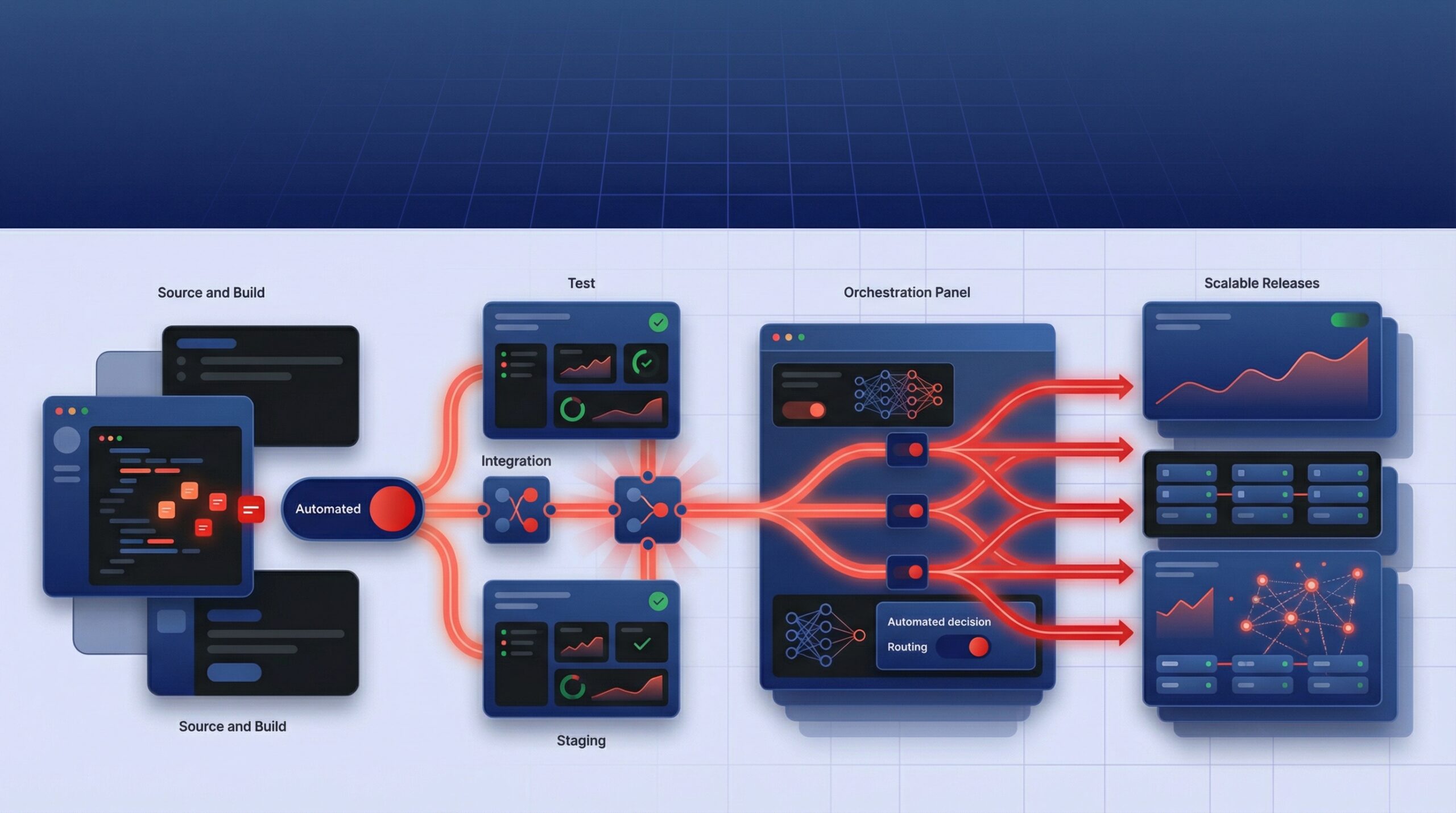
Organizations implementing GitOps often combine it with automated CI/CD pipelines to improve release consistency, deployment speed, and infrastructure reliability across Kubernetes environments. Teams looking to modernize release workflows can also explore AcmeMinds’ guide to automating deployment pipelines for scalable releases
GitOps Improves Rollback Capabilities
Since every infrastructure version is stored in Git, teams can quickly revert to previously stable configurations during deployment failures or production incidents. This significantly reduces mean time to recovery, minimizes deployment related outages, and improves production stability.
Why Declarative Infrastructure Matters in Kubernetes
GitOps follows a declarative infrastructure model where organizations define the desired system state instead of manually executing operational changes. This simplifies Kubernetes management, improves infrastructure standardization, and enables more scalable cloud native operations.
Why Enterprises Are Adopting GitOps
GitOps adoption is accelerating because enterprises need more scalable, secure, and reliable ways to manage Kubernetes infrastructure. As cloud native environments grow across multiple clusters and cloud platforms, traditional deployment methods often create operational inefficiencies, governance gaps, and deployment inconsistencies.
GitOps helps organizations improve deployment automation, infrastructure visibility, operational control, and environment consistency at enterprise scale.
Faster and More Reliable Kubernetes Deployments
GitOps automates deployment synchronization across Kubernetes environments, reducing dependency on manual operational processes and improving deployment reliability.
Organizations adopting GitOps commonly benefit from:
- Faster software release cycles
- Lower deployment failure rates
- Reduced manual intervention
- Improved infrastructure consistency across environments
This becomes increasingly important for enterprises managing large scale Kubernetes deployments across distributed cloud environments.
Stronger Security and Compliance Governance
GitOps creates fully auditable infrastructure workflows by storing every deployment change inside version controlled Git repositories.
Each infrastructure modification can be reviewed, approved, tracked, and validated before deployment. This improves security governance, strengthens operational accountability, and helps organizations meet compliance requirements more efficiently.
Improved Infrastructure Standardization
Large enterprises often struggle with inconsistent Kubernetes configurations across teams, environments, and cloud platforms. GitOps enables standardized deployment templates, infrastructure policies, and operational workflows across the organization.
This helps businesses maintain greater consistency across multi cluster, hybrid cloud, and multi region Kubernetes environments while reducing operational complexity.
For example, enterprises managing Kubernetes clusters across AWS, Azure, and on premises environments often use GitOps workflows to maintain consistent deployment policies and infrastructure configurations across all environments.
Better Developer Productivity
GitOps simplifies deployment workflows by reducing operational bottlenecks between development and infrastructure teams.
Developers can focus on faster application delivery while platform engineering teams maintain centralized infrastructure governance, deployment policies, and operational consistency. This improves engineering efficiency without compromising security or operational control.
GitOps Tools Powering Kubernetes Automation
Several platforms have become essential components of modern GitOps based Kubernetes environments. These tools help organizations automate deployments, maintain infrastructure consistency, and simplify Kubernetes operations at scale.
Argo CD
Argo CD is one of the most widely adopted GitOps platforms for Kubernetes environments. It continuously synchronizes Kubernetes clusters with the desired configurations stored in Git repositories, helping teams automate deployment management with greater visibility and control.
Key capabilities include:
- Automated Kubernetes synchronization
- Deployment visualization dashboards
- Multi cluster deployment management
- Declarative application delivery
Argo CD is commonly used by enterprises managing large scale cloud native infrastructure and complex Kubernetes deployments.
Flux CD
Flux CD is a Kubernetes native GitOps platform designed for lightweight and highly flexible deployment automation. It is often preferred by organizations that require deeper Kubernetes integrations and more customizable GitOps workflows.
Flux CD is commonly adopted for:
- Lightweight Kubernetes automation
- Flexible infrastructure integrations
- Advanced deployment customization
- Kubernetes native operational workflows
Helm and Kustomize
GitOps workflows frequently integrate with Helm and Kustomize to simplify Kubernetes configuration management across environments.
Helm helps organizations standardize Kubernetes application packaging and deployment management, while Kustomize enables environment specific configuration customization without modifying the original application manifest.
Together, these tools improve deployment consistency and simplify infrastructure standardization across development, staging, and production environments.
GitOps and DevSecOps
Security has become a critical priority in modern Kubernetes environments, especially as enterprises manage large scale cloud native infrastructure across multiple clusters and cloud platforms. GitOps strengthens Kubernetes security by embedding governance, policy validation, and auditability directly into deployment workflows.
Infrastructure Changes Become Fully Auditable
GitOps stores every infrastructure modification inside version controlled Git repositories, creating complete visibility into deployment activity and operational changes.
Security and platform teams can easily track:
- Who modified infrastructure
- What configurations were changed
- When deployments occurred
- Which approvals were completed
This improves operational accountability and simplifies compliance management across enterprise environments.
Automating Security and Compliance in GitOps Pipelines
Organizations can integrate automated security and compliance validation directly into GitOps pipelines using admission controllers, policy as code frameworks, and infrastructure validation checks.
This helps prevent non compliant configurations, insecure deployments, and unauthorized infrastructure changes from reaching production environments.
Reduced Direct Access to Production Environments
GitOps minimizes the need for manual access to Kubernetes clusters by managing infrastructure changes through controlled Git based workflows.
This reduces:
- Privileged access exposure
- Human configuration errors
- Security risks from uncontrolled infrastructure modifications
As a result, organizations gain stronger infrastructure governance while improving operational security across Kubernetes environments.
Common GitOps Challenges and Best Practices
While GitOps improves Kubernetes automation, deployment consistency, and operational governance, successful implementation requires strong infrastructure management practices. As enterprise Kubernetes environments scale, organizations must address several operational and architectural challenges to maximize GitOps effectiveness.
Secure Secret Management Is Critical
One of the biggest GitOps challenges involves managing sensitive credentials securely. Since Git repositories should not store secrets directly, organizations must integrate secure secret management solutions into their Kubernetes workflows.
Commonly used solutions include:
- HashiCorp Vault
- Sealed Secrets
- External Secrets Operator
Implementing centralized secret management helps strengthen Kubernetes security while maintaining compliance across enterprise environments.
Repository Structure Must Be Scalable
As Kubernetes infrastructure expands across teams, environments, and cloud platforms, Git repository organization becomes increasingly important.
Poor repository structures often lead to:
- Deployment confusion
- Environment duplication
- Operational fragmentation
Organizations should standardize repository structures by clearly separating application configurations, infrastructure configurations, and environment specific deployments. This improves scalability, operational clarity, and deployment consistency.
Multi Cluster Kubernetes Management Requires Strong Governance
Large enterprises frequently manage Kubernetes clusters across multiple regions and cloud providers. Maintaining synchronization, governance consistency, and deployment visibility across these environments can become operationally complex.
GitOps environments should include:
- Centralized policy management
- Continuous cluster synchronization monitoring
- Infrastructure drift detection
- Standardized deployment workflows
These practices help organizations maintain operational consistency across distributed Kubernetes environments.
Automated Validation Improves Deployment Reliability
Every infrastructure change should pass through automated validation before reaching production environments.
Organizations should integrate:
- Security scanning
- Policy validation
- Configuration testing
- Deployment verification
Automated validation significantly reduces deployment failures and improves infrastructure reliability across Kubernetes environments.
Progressive Deployment Strategies Reduce Operational Risk
GitOps works effectively with progressive deployment models such as canary deployments, blue green deployments, and automated rollback workflows.
These deployment strategies help organizations minimize production risks, improve release stability, and maintain higher application availability during infrastructure updates.
The Future of GitOps in Enterprise Infrastructure
GitOps is rapidly becoming the operational standard for modern Kubernetes environments as enterprises scale cloud native infrastructure across multi cloud and hybrid deployments. Beyond deployment automation, organizations are increasingly adopting GitOps to improve infrastructure consistency, strengthen security governance, simplify Kubernetes management, and support platform engineering initiatives at scale.
As AI driven automation and distributed cloud environments continue evolving, GitOps will play an even bigger role in enabling scalable, secure, and automated Kubernetes operations. For enterprises investing in cloud native infrastructure, GitOps is no longer an emerging DevOps practice. It is becoming a foundational strategy for modern infrastructure management.
As enterprises continue modernizing Kubernetes and cloud native infrastructure, GitOps is becoming a foundational part of scalable DevOps strategies supported by automation, CI/CD modernization, infrastructure governance, and cloud native engineering practices delivered by AcmeMinds.
FAQs
1. What is GitOps in Kubernetes?
GitOps is a deployment methodology that uses Git repositories as the single source of truth for Kubernetes infrastructure and application configurations. Infrastructure changes are automatically synchronized with Kubernetes clusters through continuous reconciliation.
2. Why is GitOps important for Kubernetes?
GitOps improves Kubernetes deployment reliability, reduces configuration drift, strengthens security governance, and enables scalable infrastructure automation across cloud native environments.
3. What are the main benefits of GitOps for Kubernetes?
GitOps improves Kubernetes deployment reliability by enabling faster releases, automated infrastructure synchronization, simplified rollbacks, stronger security auditing, and consistent infrastructure management across environments.
4. Which tools are commonly used for GitOps?
Popular GitOps tools include Argo CD and Flux CD for deployment automation, Helm and Kustomize for Kubernetes configuration management, and HashiCorp Vault for secure secret management.
5. Is GitOps part of DevOps?
Yes. GitOps extends DevOps practices by introducing declarative infrastructure management and automated Kubernetes reconciliation using Git based workflows.
6. What is the difference between CI/CD and GitOps?
CI/CD pipelines primarily automate software delivery and testing. GitOps focuses on maintaining the desired infrastructure and application state inside Kubernetes environments through Git driven automation.
More on DevOps

Building Secure APIs in 2026: Best Practices for Authentication and Authorization