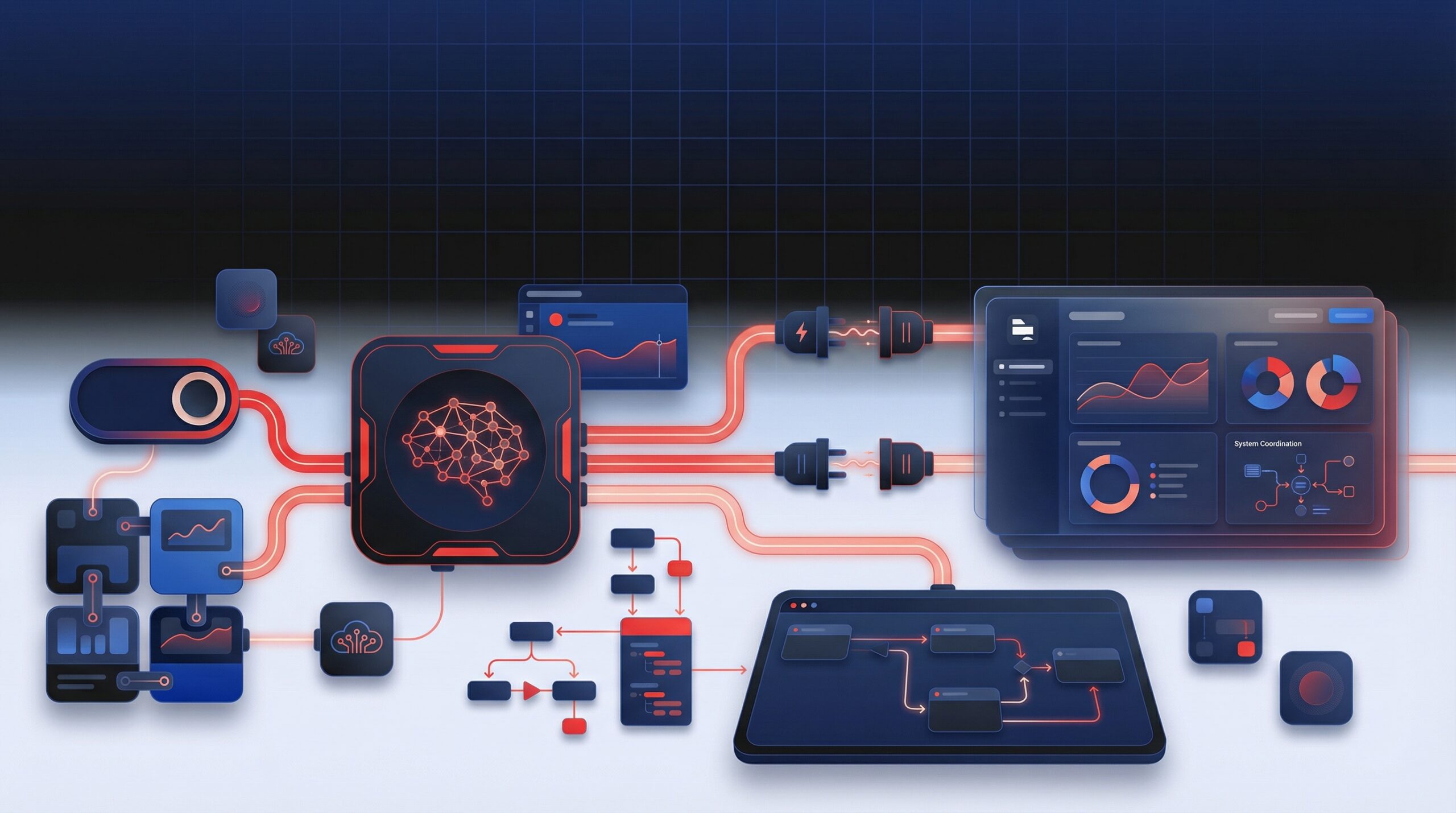
AI in Custom Software Development

Artificial intelligence is rapidly reshaping how software products are designed, developed, and scaled. Businesses today require applications that can process large datasets, automate decisions, and continuously improve user experiences.
Custom software development combined with artificial intelligence enables organizations to build applications that are not only functional but also intelligent. AI powered software can analyze behavior patterns, automate complex workflows, and generate insights that help businesses make better decisions.
According to McKinsey & Company, companies adopting AI technologies have reported productivity improvements of up to 40 percent in certain business functions, highlighting the strategic value of AI driven systems.
For companies investing in digital transformation, AI integrated custom software development has become a major driver of operational efficiency and competitive differentiation.
What Is AI in Custom Software Development?
AI in custom software development refers to integrating artificial intelligence technologies such as machine learning, predictive analytics, and natural language processing into software applications designed for specific business needs.
Unlike off the shelf software tools, AI powered custom software solutions are tailored to an organization’s workflows, data models, and operational objectives.
These applications can perform advanced tasks such as
• Predictive data analysis
• Intelligent automation of workflows
• Customer behavior prediction
• Real time decision support
• Personalized user experiences
By combining AI technologies with custom software engineering, businesses can build solutions that continuously improve and adapt to changing user needs.
Why Businesses Are Integrating AI Into Custom Software?
Organizations across industries are adopting AI driven custom software development for several reasons.
Data Driven Decision Making
Artificial intelligence helps organizations extract meaningful insights from large volumes of business data. Custom AI software platforms analyze operational patterns, customer behavior, and market trends to support strategic decisions.
Automation of Business Processes
AI automation helps eliminate repetitive manual tasks across departments such as customer service, operations, and logistics.
Personalized Customer Experiences
AI powered applications allow businesses to deliver highly personalized user journeys based on individual preferences and usage patterns.
Competitive Advantage
Organizations that integrate AI capabilities into custom software can innovate faster and deliver smarter digital services to their customers.
Key Benefits of AI in Custom Software Development
Faster Development Cycles
AI assisted development tools help automate repetitive coding tasks and reduce development timelines. This allows engineering teams to focus on solving complex business problems rather than writing boilerplate code.
Improved Software Quality
AI powered testing tools can automatically detect bugs, analyze error patterns, and improve test coverage during the development lifecycle.
Advanced Data Insights
Custom software integrated with AI algorithms can analyze large datasets and generate actionable insights for business teams.
Enhanced Customer Experience
AI powered features such as recommendation engines and conversational interfaces improve user engagement and satisfaction.
Operational Efficiency
Organizations using AI driven automation often reduce operational costs while improving accuracy and productivity.
Real World Use Cases From Custom Software Projects
Real world implementations demonstrate how custom software solutions can solve complex business challenges when combined with intelligent automation and analytics.
Enterprise Data Intelligence Platforms
Modern enterprises rely on data driven insights to guide strategic decisions, yet business data is often scattered across multiple systems such as CRM platforms, financial tools, and operational databases. Custom enterprise data platforms help organizations consolidate these datasets into a unified analytics environment. These solutions are designed to automate data pipelines, streamline reporting workflows, and deliver real time dashboards that provide clear visibility into business performance. View case study
AI enablement within these platforms helps organizations analyze large volumes of data more efficiently and uncover patterns that support smarter decision making. Capabilities such as intelligent data classification, anomaly detection, and predictive analytics allow businesses to transform raw enterprise data into actionable insights. By integrating artificial intelligence into custom software solutions, organizations can improve operational visibility, reduce manual data processing, and make faster data driven decisions.
Healthcare Care Coordination Platforms
Healthcare organizations increasingly rely on digital platforms that help care teams manage patient information, coordinate treatments, and streamline clinical workflows. Custom healthcare software platforms enable providers to centralize patient data, improve collaboration between clinical and administrative teams, and ensure secure handling of sensitive medical records. These platforms are typically built with strong compliance frameworks and secure system architectures to support healthcare operations efficiently. View case study
AI model integration in such healthcare platforms helps care teams derive deeper insights from patient data and operational workflows. Capabilities such as intelligent data analysis, automated care recommendations, and predictive insights support better clinical decision making and improved patient outcomes. By embedding artificial intelligence within custom healthcare software solutions, organizations can enhance care coordination, reduce manual administrative effort, and enable more proactive and data driven healthcare delivery.
AI Across the Software Development Lifecycle
Artificial intelligence is increasingly influencing every stage of modern software engineering.
- Requirement Analysis – AI tools analyze historical product data and user behavior to identify feature requirements and usage patterns.
- Software Architecture and Design – AI driven tools assist developers in selecting optimal architectures and infrastructure configurations.
- Development and Coding – AI coding assistants help engineers generate code suggestions, documentation, and debugging insights.
- Testing and Quality Assurance – AI powered testing tools generate automated test cases and detect anomalies in application behavior.
- Deployment and Monitoring – AI driven monitoring systems track application performance and predict infrastructure failures before they occur.
Challenges of Implementing AI in Custom Software
Despite its advantages, integrating AI into enterprise software development presents several challenges.
- Data Quality and Availability – AI systems require high quality training data to generate reliable predictions and insights.
- Infrastructure Complexity – AI workloads often require advanced cloud infrastructure and computing power.
- Regulatory and Security Concerns – Organizations must ensure AI powered software complies with privacy regulations and security standards.
- Skill Gaps – Successful implementation requires expertise in both artificial intelligence and software engineering disciplines.
Future Trends in AI Powered Software Development
As organizations increasingly adopt intelligent technologies, several trends are emerging that will define the next generation of custom software solutions.
AI Assisted Development Platforms
AI powered development tools are becoming an integral part of engineering workflows. Platforms such as GitHub Copilot assist developers by generating code suggestions, improving documentation, and helping detect issues during development. These tools help teams accelerate development cycles while maintaining software quality.
Hyper Personalized Digital Applications
Modern software platforms are increasingly using AI driven recommendation engines to deliver personalized digital experiences. Platforms like Netflix and Amazon rely heavily on machine learning models to analyze user behavior and recommend relevant content, products, and services in real time.
Intelligent Enterprise Systems
Organizations are building enterprise platforms that combine operational data with AI powered analytics. Tools such as Salesforce Einstein integrate artificial intelligence across CRM systems to provide predictive insights for sales, marketing, and customer service teams.
Predictive Business Applications
AI powered software increasingly uses predictive analytics to forecast demand, identify risks, and automate decision making. For example, recommendation systems like the one developed for Pinterest analyze billions of data points to deliver personalized content and improve user engagement.
Conclusion
Artificial intelligence is transforming the future of custom software development. Businesses that integrate AI capabilities into their digital platforms can automate operations, gain deeper insights from data, and deliver more personalized customer experiences.
Custom software combined with AI technologies enables organizations to build intelligent applications tailored to their unique workflows and strategic objectives.
For companies focused on long term digital innovation, AI powered custom software development represents a critical investment in future competitiveness.
FAQs
1. What is AI in custom software development?
AI in custom software development refers to integrating artificial intelligence technologies such as machine learning and predictive analytics into software applications designed specifically for a business.
2. What are the benefits of AI in software development?
AI improves software development by enabling automation, predictive insights, faster testing, and enhanced user experiences.
3. Which industries use AI powered custom software?
Industries such as healthcare, finance, transportation, retail, and manufacturing widely use AI powered custom software solutions.
4. How much does AI software development cost?
The cost depends on factors such as project complexity, infrastructure requirements, and the type of AI technologies used.
5. What technologies are used in AI software development?
Common technologies include machine learning frameworks, natural language processing models, predictive analytics platforms, and cloud based AI services.
6. How do businesses start building AI powered custom software?
Organizations typically begin by identifying business use cases, collecting relevant data, defining technical requirements, and partnering with an experienced custom software development company.
More on Enterprise
How to Transform Patient Data with Clinical Intelligence platform